
Table of Contents
Picture this: it’s 1999, you’re tearing open a Pokémon booster pack on the school bus, praying for a holographic Charizard. Back then, that card felt like treasure. Now, it actually is.
The world of Pokémon card collecting has evolved into something nobody back in the late ’90s could have predicted. We’re talking about a market worth over $2.2 billion in global sales in 2024 alone. We’re talking about auction rooms where bidding wars erupt over single pieces of cardboard. We’re talking about one card — just one — selling for $16,492,000 in February 2026.
Whether you’re a lifelong collector, a curious newcomer who just rediscovered a dusty shoebox of cards in the attic, or someone who simply can’t believe a Pokémon card sold for more than most people’s houses — this guide covers everything. You’ll learn which cards command the biggest prices, what makes them so extraordinarily valuable, and why this hobby is only getting bigger.
Let’s start at the very top.
What Is the Most Expensive Pokémon Card Ever Sold?
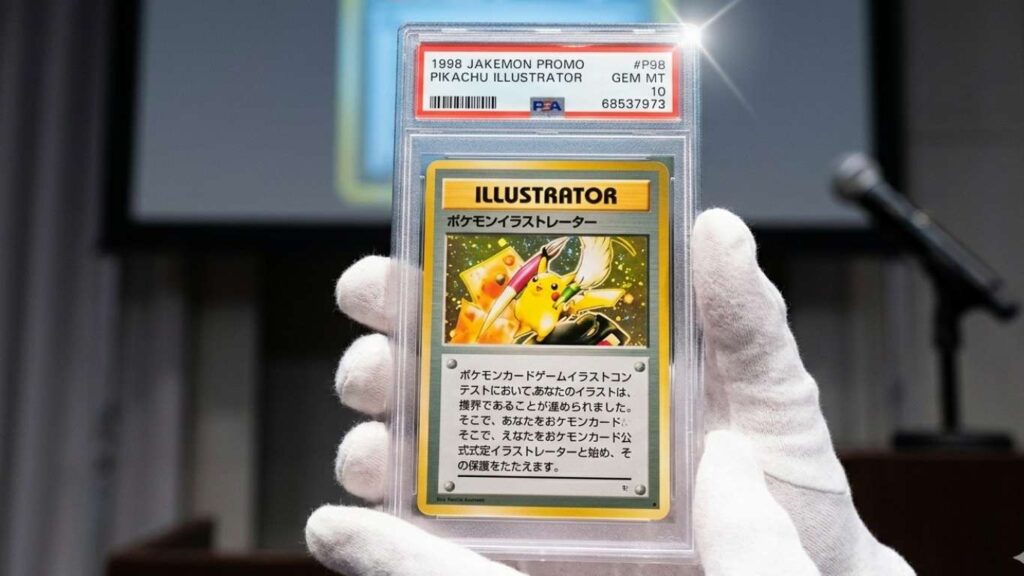
The most expensive Pokémon card ever sold is the Pikachu Illustrator PSA 10, which changed hands on February 16, 2026 for a staggering $16,492,000 at Goldin Auctions.
The seller was Logan Paul — the YouTuber-turned-boxer who had purchased it in 2021 for $5.275 million, itself a world record at the time. The buyer was AJ Scaramucci, son of businessman Anthony Scaramucci and founder of Solari Capital, who received the card from Paul’s hands in a live-streamed ceremony — complete with a $75,000 diamond-encrusted necklace it was delivered in.
A Guinness World Records adjudicator was present at the event to certify not one but two records simultaneously: the most expensive Pokémon card ever sold at auction, and the most expensive trading card ever sold at auction — across any card game, anywhere in the world.
Let that sink in. Not just the most expensive Pokémon card. The most expensive trading card in history.
The final hammer price was $13.3 million. After Goldin’s 24% buyer’s premium was added, the total reached $16,492,000. And if you’re wondering how competitive the bidding was — the auction ran for 41 days, attracted 97 separate offers, and in the final few hours alone the price surged from $6 million to $13.3 million. Bidders kept extending the sale window with last-minute bids for nearly three hours after the official close.
This is the card we’re talking about when we say “most expensive Pokémon card.” But to understand why it’s worth that much, you need to know the story behind it.
The Pikachu Illustrator: The Card That Changed Everything
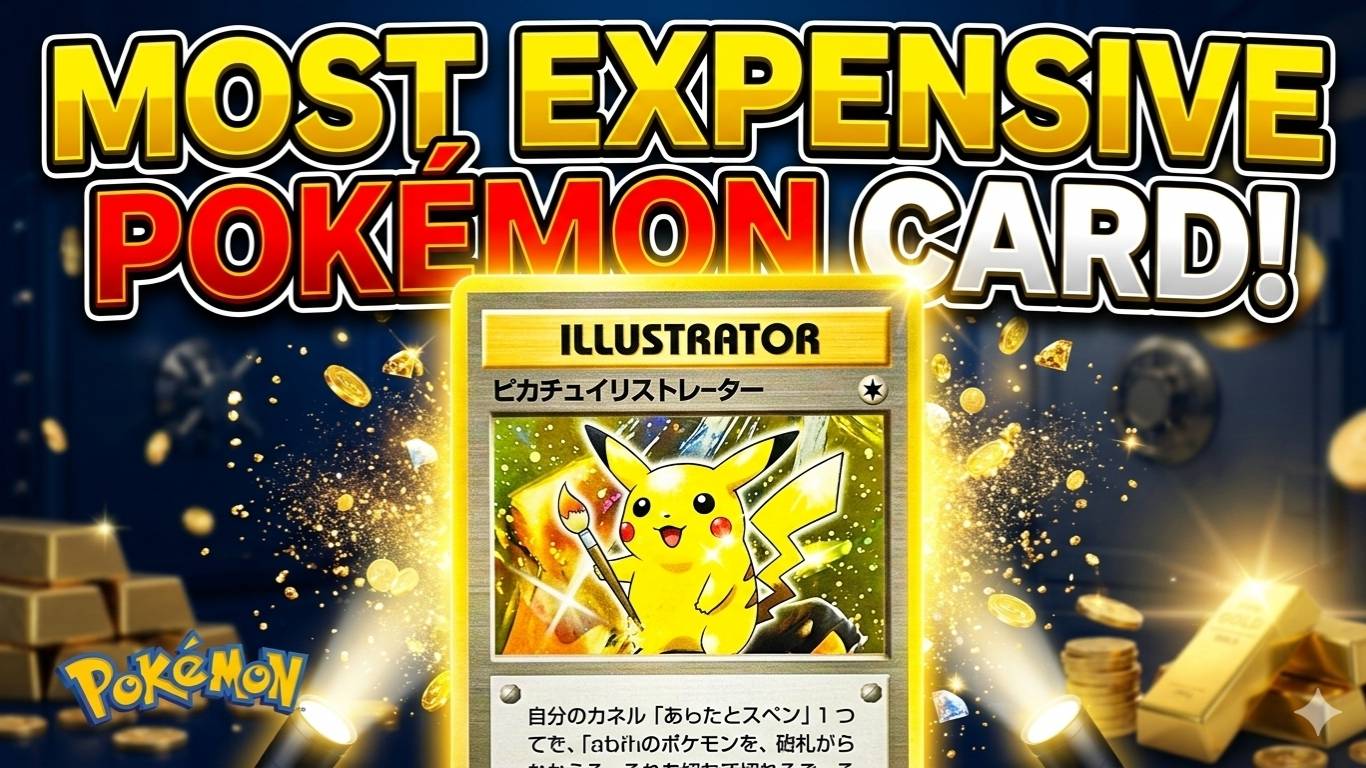
At first glance, the Pikachu Illustrator doesn’t look especially intimidating. It shows a round, cheerful Pikachu holding a paintbrush and fountain pen, with small sketches of Charmander and another Pokémon drifting beside it. It’s charming, whimsical, and distinctly old-school in its art style.
But the card itself is unlike any other in existence.
Where Did It Come From?
In 1997–1998, CoroCoro Comic — a beloved Japanese manga magazine — ran a series of Pokémon illustration contests, inviting young artists to submit their own Pokémon artwork. The winners of each contest received this card as their prize. It wasn’t produced for sale. It wasn’t printed in bulk. It wasn’t available in booster packs. It was a trophy — a one-time reward given exclusively to artists who won a creative competition.
Only 41 copies were ever produced. Thirty-nine went to contest winners. The remaining two were auctioned off years later by Yuichi Konno, one of the original Pokémon TCG designers. That’s it. Forty-one cards in the entire world.
Of those 41, only one single copy has ever received a PSA 10 (Gem Mint) grade — meaning it’s in virtually flawless condition, with perfect corners, perfect edges, and an unblemished surface. That’s the card Logan Paul owned. That’s the card that sold for $16.5 million.
What Makes It Uniquely Special?
Beyond the scarcity, the Pikachu Illustrator carries a handful of features that set it apart from every other card in the Pokémon TCG:
It says “Illustrator” instead of “Trainer.” Every other card in the game uses standard type designations. The Pikachu Illustrator is the only card ever printed with the word “Illustrator” in its card type line — a subtle but deeply meaningful distinction that marks it as something outside the normal game entirely.
It was designed by Atsuko Nishida — the original creator of Pikachu herself. The card’s artwork comes from the very person who brought the world’s most recognizable fictional creature to life.
You can’t even play it. The Pikachu Illustrator has no game mechanics. It serves no function in actual Pokémon matches. Its value is entirely tied to what it represents — art, history, and the origins of a global phenomenon.
Why Are Some Pokémon Cards Worth So Much?
Before we rank the rest of the most valuable cards ever sold, it’s worth taking a step back to understand what actually drives prices in this market. Not every old Pokémon card is worth a fortune. Plenty are worth a few dollars — or nothing at all. But certain cards converge on a set of factors that push their value into the stratosphere.
Scarcity is the foundation. The Pokémon TCG has produced billions of cards over the past 25+ years. What separates a $10 card from a $10,000 one usually comes down to how few copies exist. Tournament prizes, limited promotional releases, and prototype cards were produced in runs of fewer than 50 copies — sometimes fewer than 10.
Condition is everything. This is the factor most collectors underestimate. Professional grading services — PSA, BGS (Beckett), and CGC — evaluate cards on a precise scale and assign a grade from 1 to 10. A card graded PSA 10 (Gem Mint) is in near-perfect condition: sharp corners, pristine surface, no whitening on the edges, centered artwork. The difference between a PSA 9 and a PSA 10 can represent tens of thousands — sometimes hundreds of thousands — of dollars on a desirable card. A single crease, a scratch invisible to the naked eye, can slash a card’s value dramatically.
History and cultural significance matter deeply. Cards from the very first print runs, tournament exclusives from the late 1990s, and one-of-a-kind promotional pieces carry a weight that modern cards simply can’t replicate. These are artifacts from the beginning of a phenomenon that went on to become the highest-grossing media franchise in human history.
Iconic Pokémon drive demand. Charizard. Pikachu. Mewtwo. Lugia. These aren’t just popular characters — they’re cultural touchstones with enormous, multigenerational fan bases. A card featuring one of these Pokémon in a rare, well-preserved form will attract fierce competition from collectors worldwide.
Celebrity attention amplifies everything. When Logan Paul spent $5.275 million on a Pikachu Illustrator in 2021 and wore it around his neck at WrestleMania, the entire world suddenly cared about Pokémon card collecting. That level of mainstream exposure accelerates demand and legitimizes the market in the eyes of investors who otherwise might never have noticed it.
The Top 10 Most Expensive Pokémon Cards Ever Sold
1. Pikachu Illustrator PSA 10 — $16,492,000 (February 2026)
Already covered in depth above, but worth restating: this is the most expensive Pokémon card ever sold, and it now holds the Guinness World Record as the most expensive trading card of any kind sold at auction. There are 41 copies in existence, one of which is in PSA 10 condition. That one card just sold for over sixteen million dollars. The Pikachu Illustrator is in a category entirely its own.
2. 1997 Pikachu No. 1 Trainer Trophy Card (Gold) — ~$444,000
Long before the Pokémon TCG reached Western shores, Japan held the first official Pokémon Card Game Tournament series in 1997. The top finishers in each division received trophy cards featuring Pikachu alongside the place designation. The gold No. 1 Trainer card — awarded to first-place finishers — is extraordinarily rare, with fewer than 15 known copies in the world. A PSA 10-graded example sold for $444,000, making it one of the most valuable tournament prizes ever issued in the hobby’s history.
3. 1st Edition Shadowless Charizard (Base Set) PSA 10 — ~$420,000 (2022)
If the Pikachu Illustrator is the most expensive Pokémon card in the world, the 1st Edition Shadowless Charizard is the most famous. For a huge portion of Western collectors, this is the card. The dream card. The one that defined childhood ambitions and adult obsessions alike.
What makes it so special comes down to two printing characteristics that only exist together in the earliest production run. The 1st Edition stamp — a small badge on the left side of the card — marks it as part of the very first print run Wizards of the Coast produced when they localized the Base Set in 1999. The shadowless element refers to the absence of a drop shadow on the right side of the Pokémon art box — a subtle printing distinction present only in those earliest copies before Wizards updated the template.
The result? A card that’s become the Western face of rare Pokémon collecting. Only 121 copies exist in PSA 10 condition. In 2022, one sold through PWCC Marketplace for $420,000. In December 2025, a Heritage Auctions sale pushed the price to a new record of $550,000 — a staggering jump that shows just how much demand continues to climb. Even PSA 9 copies trade between $45,000 and $80,000.
4. Blastoise Wizards of the Coast Presentation Card — $360,000 (2021)
This is one of the most fascinating and historically unusual cards in the entire hobby. In the mid-1990s, when Wizards of the Coast was working to bring the Pokémon TCG to English-speaking markets, they created a handful of prototype cards to demonstrate their holographic printing capabilities to stakeholders. Only two copies of this Blastoise presentation card were ever made — and the location of the second one remains unknown.
The known copy features gold borders, a unique Galaxy Star Holo treatment, and typography that’s noticeably different from any standard card. It received a BGS 8.5 grade and sold for $360,000. Given that the other copy may never resurface, some collectors argue this is, in practical terms, a one-of-a-kind piece.
5. Ishihara GX Promo (Autographed) — $247,230 (2021)
Perhaps the most unusual entry on this list: this card doesn’t even feature a Pokémon. The Ishihara GX Promo depicts Tsunekazu Ishihara, the founder and president of The Pokémon Company, rendered in card form to celebrate his 60th birthday. The card was distributed exclusively to employees who attended the private birthday event — making it a bizarre but genuinely priceless slice of Pokémon corporate history.
The autographed copy received a PSA 7 grade for the card itself and a PSA 9 for Ishihara’s signature, and sold through Goldin Auctions for $247,230. Only the most devoted collectors even know this card exists, which makes owning one feel like holding a secret.
6. Pokémon Snap Bulbasaur (CoroCoro Contest Promo) — $200,000 (2025)
In 1999, CoroCoro ran a photo contest tied to the Nintendo 64 game Pokémon Snap, inviting players to submit their best in-game screenshots. The winning photos were turned into actual Pokémon cards. Only 20 copies were ever printed, each featuring fan-submitted artwork — making these some of the most unusual cards in the hobby.
In mid-2025, a PSA 9-graded Bulbasaur example sold through Fanatics Collect for $200,000, setting a record as the most expensive Bulbasaur card ever traded. It’s a remarkable price for a card most collectors have never even heard of, which speaks to just how deep the well of rare Pokémon cards runs.
7. Kangaskhan Parent/Child Promo (1998) — $150,000+
This trophy card came from one of the most heartwarming tournament formats in Pokémon history: the 1998 Parent/Child Tournament in Japan, where adults and children teamed up to compete together. The top finishing teams received this exclusive Kangaskhan card — a fitting choice given that Kangaskhan is literally known as the Parent Pokémon.
Only a handful of copies exist. The combination of extreme scarcity, unique origin story, and the quietly sentimental nature of the card makes it one of the most emotionally resonant pieces in any collection.
8. No. 1 Trainer Super Secret Battle Promo — $156,000 (2022)
In 1999, a special closed-door tournament was held exclusively for Japan’s best Pokémon players. Entry was by invitation only, granted to winners of regional qualifiers. The finalists competed at a secret location — which is actually where the card gets its name. Winners received this card, which features Mewtwo and reads, in translation: “The Pokémon Card Game Official Tournament’s champion is recognized here.”
Only seven copies were ever made. A PSA 10 example sold for $90,000 in 2020, then another PSA 10 reached $156,000 in 2022. With supply permanently fixed at seven and demand only growing, these prices are unlikely to stop climbing.
9. Umbreon Gold Star Players Reward PSA 10 — $180,000 (2024)
The Umbreon Gold Star is one of the most difficult cards to have ever obtained through legitimate means. To be eligible to receive it, players had to accumulate 70,000 XP points through the Pokémon Players Club — a system that required physically attending tournaments and consistently performing well over an extended period. Most players never got anywhere close.
The result is a card whose supply is permanently and verifiably tiny. Only two copies in the entire world hold a grade higher than PSA 9. A PSA 10 example sold for $180,000 in 2024, and given how few exist at that grade level, any future auction could push the price significantly higher.
10. Charizard Topsun Blue Back — ~$493,230
Before the Pokémon TCG officially launched, a Japanese confectionery company called Topsun produced Pokémon cards packaged inside gum. These pre-TCG cards predate Wizards of the Coast’s involvement entirely, and the Charizard version with a blue back is considered one of the earliest mass-produced Charizard cards ever made.
It has no game mechanics. It barely resembles the standard TCG format. But it’s a Charizard, it’s from before Pokémon officially existed as a card game, and there aren’t many of them left in good condition. In top-tier graded form, this card has sold for nearly half a million dollars — which tells you everything you need to know about how collectors feel about early Charizard history.
Read more: 1 Billion Won to USD: How Much Is 1,000,000,000 Korean Won in US Dollars?
How Pokémon Cards Are Graded — And Why It Matters So Much
If you’re new to rare card collecting, the grading system can seem confusing at first. But once you understand how it works, you’ll realize it’s the single most important factor in determining a card’s real-world value.
The three major grading services are PSA (Professional Sports Authenticator), BGS (Beckett Grading Services), and CGC (Certified Guaranty Company). Each service physically receives your card, evaluates it under precise conditions, assigns a grade, and then seals it inside a hard plastic case that protects it and displays the grade permanently.
PSA grades on a scale of 1 to 10. A PSA 10 — called Gem Mint — means the card is as close to perfect as a physical card can be: sharp corners with no whitening, clean edges, smooth surface with no scratches or print defects, and well-centered artwork. A PSA 9 (Mint) means the card is excellent but shows minor imperfections that prevent it from being perfect.
The price difference between grades can be astonishing. Take the 1st Edition Shadowless Charizard: a PSA 9 version trades for $45,000–$80,000. A PSA 10 has sold for over $550,000. The same card, with the difference of a single corner’s sharpness, is worth nearly ten times as much.
BGS uses a similar scale but with sub-grades for centering, corners, edges, and surface. A BGS 9.5 is widely considered comparable to a PSA 10 in prestige, while a BGS 10 “Pristine” — reserved for cards that are essentially perfect across all four sub-categories — is extraordinarily rare and commands a massive premium.
The takeaway: if you believe you have a valuable card, getting it professionally graded is almost always worth it. The cost of grading is a small fraction of the potential value increase.
Is the Pokémon Card Market a Good Investment?
This is the question on everyone’s mind — and there’s no simple yes or no answer. The market has produced extraordinary returns for early investors, but it also carries real risks that any serious buyer should understand.
The Case For
The numbers are hard to argue with. Global Pokémon TCG sales exceeded $2.2 billion in 2024. The 1st Edition Shadowless Charizard has appreciated from a few hundred dollars in the early 2000s to over $500,000 today. The Pikachu Illustrator sold for $5.275 million in 2021 and $16.5 million in 2026 — a 213% gain in just five years on an asset that technically fits in your shirt pocket.
Vintage cards in high grades — PSA 9 and PSA 10 — from iconic sets have historically outpaced inflation and, in many cases, outpaced the broader stock market. The market’s global reach means demand comes from collectors in the US, Europe, Japan, Australia, and beyond.
The Risks to Understand
The market isn’t without volatility. Prices declined 30–50% between 2021 and 2023 as the post-pandemic collecting boom cooled. Counterfeits remain a real concern — the only reliable protection is buying graded cards from established auction houses or submitting suspicious cards for professional evaluation before purchasing. Storage matters enormously: humidity, light exposure, and improper handling can damage a card enough to affect its grade and, by extension, its value significantly.
Liquidity can also be an issue at the high end. A $400,000 card is not something you can easily convert to cash quickly the way you might a stock.
The Practical Advice
Focus on cards with established scarcity — tournament prizes, promotional releases with documented print runs, and vintage Base Set cards in high grades. Prioritize condition above all else. Buy from reputable, authenticated sources. Store cards properly in acid-free sleeves inside hard protective cases. And if you’re entering the market as an investment rather than a hobby, be prepared for the long game rather than quick flips.
Could You Have a Valuable Card Sitting at Home?
This is where things get genuinely exciting. Millions of people have childhood collections gathering dust in attics, basements, and closets — and some of those collections contain cards worth real money.
Here’s how to assess what you might have:
Step one: identify the set. Look at the bottom right corner of the card for the set symbol. Base Set, Jungle, Fossil, and Team Rocket cards from the original Wizards of the Coast era (1999–2003) are the most likely to have significant value.
Step two: look for the 1st Edition stamp. On the left side of the card, near the middle, there may be a small circular badge that reads “Edition 1.” If it’s there, you likely have a first print card — which is substantially more valuable than later printings.
Step three: check for the shadowless feature. On Base Set cards, look at the right edge of the Pokémon’s artwork box. Standard prints have a slight drop shadow there. If there’s no shadow, you may have a rare shadowless copy from the very first production run.
Step four: assess the condition honestly. Hold the card under good lighting and look at the corners, edges, and surface. Any bending, scratching, or white wear on the edges will reduce its value. Be honest with yourself — condition is everything.
Step five: check recently sold eBay listings. Search for the card name along with its grading (e.g., “1st Edition Charizard PSA 10”) and filter by Sold Items to see what real buyers are actually paying, not just what sellers are asking.
Step six: consider professional grading. For any card you believe might be worth $50 or more, grading through PSA, BGS, or CGC is worth the investment. The authentication and encapsulation alone makes the card far easier to sell, and a top grade can multiply its value many times over.
The Bigger Picture: Why Pokémon Cards Keep Rising in Value
Pokémon as a franchise has been with us for nearly 30 years, and it shows no meaningful signs of fading. New generations of children discover it through video games, the animated series, and social media every year — creating a constant pipeline of future collectors. Meanwhile, the adults who grew up with the original Base Set are now in their 30s and 40s, with real disposable income and a deep emotional connection to the cards they loved as kids.
That combination — continuous new fans feeding into the ecosystem, and nostalgic adult collectors driving fierce competition for vintage cards — is a powerful structural engine for long-term demand.
The fact that the most expensive Pokémon card in the world just sold for $16.5 million in early 2026 isn’t a fluke or a bubble moment. It’s the logical endpoint of a 25-year journey that turned a children’s card game into one of the most significant collectibles markets on the planet.
The ceiling, as far as anyone can tell, hasn’t been found yet.
Frequently Asked Questions
What is the most expensive Pokémon card ever sold?
The Pikachu Illustrator PSA 10 is the most expensive Pokémon card ever sold. It sold for $16,492,000 on February 16, 2026 through Goldin Auctions when Logan Paul sold it to AJ Scaramucci. It holds the Guinness World Record as both the most expensive Pokémon card and the most expensive trading card of any kind sold at auction.
What makes the Pikachu Illustrator so valuable?
Only 41 copies were ever produced, awarded to winners of a 1997–1998 Japanese illustration contest. It’s the only card in the Pokémon TCG to say “Illustrator” instead of “Trainer,” and only one copy in the world has ever received a PSA 10 grade. Its artwork was designed by Atsuko Nishida, the original creator of Pikachu.
What is the most expensive Pokémon card for Western collectors?
The 1st Edition Shadowless Charizard from the 1999 Base Set is considered the holy grail of Western Pokémon collecting. A PSA 10-graded example reached $550,000 at Heritage Auctions in December 2025.
How many Pikachu Illustrator cards exist?
41 copies were officially produced. Of those, only one has ever received a PSA 10 (Gem Mint) grade.
Is it worth getting old Pokémon cards graded?
For any card you believe might be worth $50 or more — especially vintage Base Set holographics, 1st Edition cards, or shadowless variants — professional grading through PSA, BGS, or CGC is generally worth the cost. A top grade can multiply a card’s value dramatically.
Are Pokémon cards a good investment?
High-grade vintage cards from iconic sets have historically shown strong appreciation. However, like any collectible market, values can be volatile. Educate yourself on grading, scarcity, and market trends before making significant purchases, and always buy from reputable, authenticated sources.
- The Most Expensive Pokémon Card in the World (2026): A Complete Collector’s Guide
- 1 Billion Won to USD: How Much Is 1,000,000,000 Korean Won in US Dollars?
- The Ultimate Guide to the Gamestop Credit card (2026) — Is It Worth It for Gamers?
- Fastest Animal in the World: The Fastest Speed Recorders in Nature
- Netflix Student Discount: All Students Need to Know in 2026