
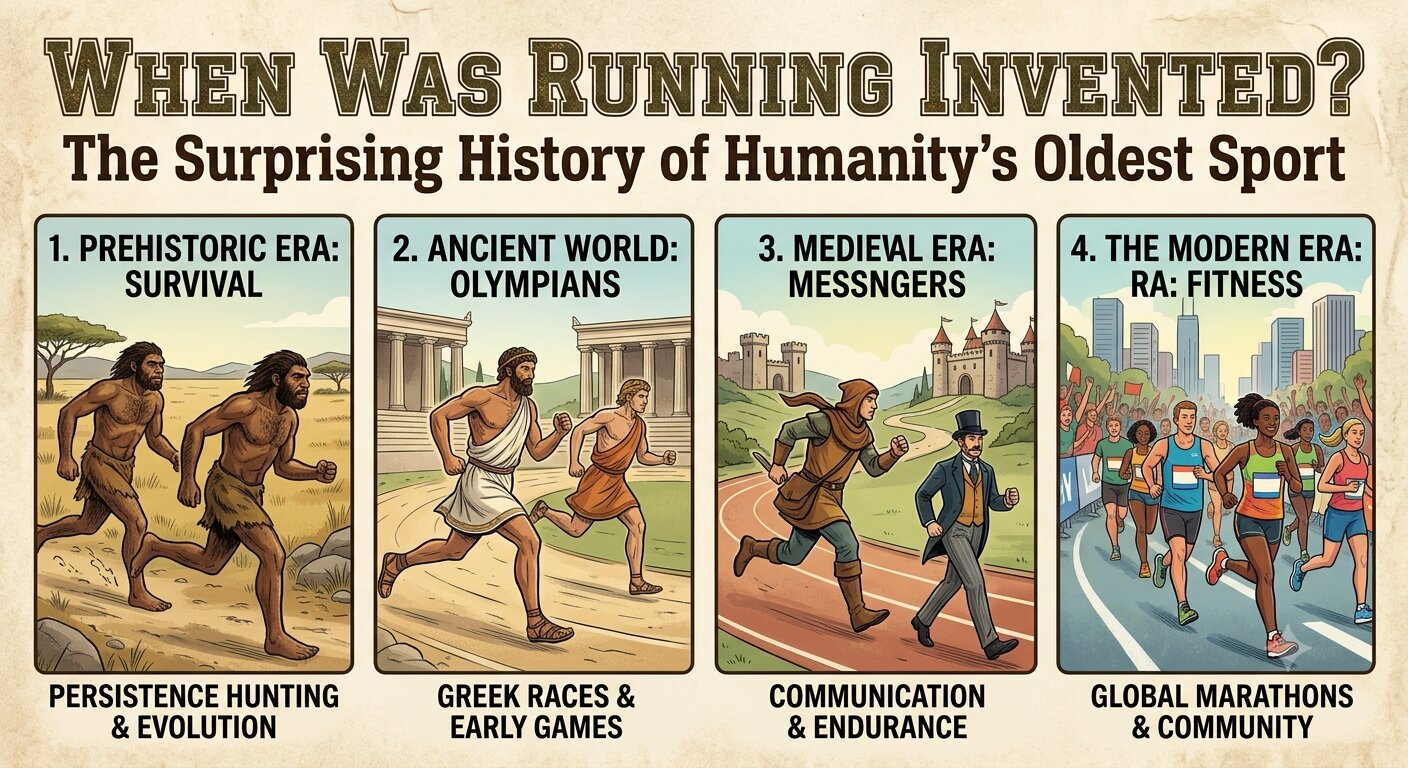
Ask a friend “when was running invented?” and you’ll probably get a confused laugh. Running feels less like an invention and more like something we’ve always just… done. But here’s the twist: running wasn’t invented in a single moment by a single person. It evolved — quite literally — over millions of years, and it has a documented history that stretches from prehistoric hunting grounds to the modern marathon.
If you’ve ever wondered how a simple act of putting one foot in front of the other became the world’s most popular sport and fitness activity, you’re in the right place. Let’s dig into the real, fascinating timeline behind the origin of running.

When Was Running Invented? The Quick Answer
Running wasn’t “invented” — it evolved. Scientists trace the origins of human running back roughly 2 million years ago, to early hominins like Homo erectus, who developed the physical traits needed for endurance running as a survival strategy. Running as an organized sport, however, dates back to 776 BCE, when foot races were held at the very first recorded Olympic Games in ancient Greece.
So there are really two answers to “when did running start”:
- As a biological ability: roughly 2 million years ago
- As a formal, competitive sport: 776 BCE
Let’s unpack both.
The Evolutionary Origins of Running
Long before running shoes, stopwatches, or race bibs, running was a matter of life and death. Anthropologists and evolutionary biologists — most notably Dennis Bramble and Daniel Lieberman of Harvard University — have argued that humans didn’t just learn to run; we were built for it.
Their research, known as the “endurance running hypothesis,” suggests that early humans evolved specific physical adaptations that separated us from other primates:
- Long legs and short toes for efficient stride mechanics
- A nuchal ligament at the back of the neck to stabilize the head while running
- Large gluteal muscles that only activate significantly during running, not walking
- An efficient sweating system, allowing humans to cool down while covering long distances — something most animals can’t do
- A springy Achilles tendon that stores and releases energy with every stride
These traits point to one central theory: our ancestors used persistence hunting, a technique where humans would chase prey — often faster animals like antelope — over long distances in extreme heat until the animal overheated and collapsed from exhaustion. Humans couldn’t outsprint most animals, but thanks to superior heat regulation and stamina, they could out-last them.
This means the true origin of running isn’t a sport at all. It’s survival. Long before running was about fitness or competition, it was one of the reasons our species survived.
Running in Ancient Civilizations
Once early humans settled into agricultural societies, running took on new meanings — communication, ritual, and eventually, competition.
Ancient Egypt
One of the earliest documented examples of running as a formalized activity comes from ancient Egypt around 3000 BCE, during the Heb-Sed festival. Pharaohs were required to run a ceremonial course in front of witnesses to prove they still had the physical vigor to rule. It wasn’t about winning a race — it was about proving strength and legitimacy as a leader.
Read more: How to Fix Shaky Hands Photography: A Complete Guide to Sharper, Steadier Shots
Ancient Greece and the Legendary Messengers
Greece is where running truly starts to resemble the sport we know today. The Greeks had professional long-distance runners called hemerodromoi, or “day-runners,” who carried messages, military orders, and news between cities — sometimes covering incredible distances in a single day.
This is also where the most famous (if historically debated) running legend comes from: Pheidippides, the messenger said to have run roughly 25 miles from the battlefield of Marathon to Athens to announce a Greek military victory, before collapsing. Whether or not the story is entirely accurate, it later inspired the creation of the modern marathon — one of the most iconic distances in running history.
Running as an Organized Sport: The First Olympics
If you want a precise date for when running became a competitive sport, look no further than 776 BCE. The first recorded Ancient Olympic Games took place in Olympia, Greece, and featured a single event: the stadion race, a sprint of about 192 meters (roughly 210 yards).
For over a century, this one race was the entire Olympic Games. Eventually, longer-distance races were added, along with other athletic events, but running remained the foundation of Greek athletic culture. Winners were celebrated as heroes, immortalized in poetry and sculpture — an early sign of just how deeply humans would come to admire runners.
The Quiet Centuries: Running Through the Middle Ages
Running didn’t disappear after antiquity, but it did become less formalized. During the Middle Ages, running was mostly practical — used by messengers, soldiers, and hunters — rather than something practiced as organized sport. It wasn’t until the 18th and 19th centuries that competitive running resurfaced in a big way, particularly in Britain, through a sport called pedestrianism.
Pedestrianism involved competitive walking and running races, often for prize money, and drew massive crowds. It laid important groundwork for the structured athletics and track-and-field culture that would follow.
The Birth of Modern Running and the Marathon
The modern Olympic Games, revived in 1896 in Athens, brought running back onto the world stage. Fittingly, the very first modern marathon was run at these Games, inspired directly by the Pheidippides legend. It covered roughly 25 miles, and a Greek water-carrier named Spyridon Louis won it, becoming a national hero overnight.
The marathon distance was later standardized to 26.2 miles at the 1908 London Olympics — reportedly so the race could start at Windsor Castle and finish in front of the royal box at the stadium. That oddly specific royal request is why marathoners today run 26.2 miles instead of a rounder number.
From here, running events multiplied. Track and field became a cornerstone of the Olympics, and long-distance road races began appearing around the world, including the Boston Marathon, first run in 1897 — making it the world’s oldest annual marathon.
The Jogging Boom: Running for Everyone
For most of history, running was reserved for messengers, soldiers, and elite athletes. That changed dramatically in the mid-20th century.
In 1962, New Zealand coach Arthur Lydiard founded one of the world’s first public jogging clubs, promoting running as a tool for everyday fitness rather than competition. The idea crossed the Pacific when American coach Bill Bowerman — who would later co-found Nike — visited Lydiard and brought the concept of “jogging” back to the United States.
Bowerman’s 1966 book, Jogging, sparked a nationwide movement. Around the same time, Dr. Kenneth Cooper’s 1968 book Aerobics gave running a scientific stamp of approval, linking regular cardiovascular exercise to long-term health.
By the 1970s, running had transformed from a niche athletic pursuit into a mainstream fitness phenomenon. Road races, fun runs, and recreational jogging exploded in popularity — a trend that hasn’t slowed down since.
Running Today: A Global Movement
Today, running is one of the most accessible and widely practiced physical activities on the planet. It requires no equipment beyond a good pair of shoes, no membership, and no special skill to begin. From casual joggers to ultramarathon runners, from the Boston Marathon to neighborhood 5Ks, running has evolved into a universal language of health, discipline, and community.
Modern running culture also embraces:
- Trail and ultra-running, pushing endurance limits in natural terrain
- Data-driven training, using GPS watches and running apps
- Virtual races and global running communities, connecting runners worldwide
- Running as mental health support, backed by growing scientific research
What began as a survival mechanism 2 million years ago has become a global lifestyle practiced by hundreds of millions of people.
Read more: Things to Do with Kids (That Don’t Make You Want to Fake a Work Emergency)
Frequently Asked Questions About the History of Running
When was running invented? Running wasn’t invented at a single point in time. It evolved biologically around 2 million years ago in early human ancestors, while running as an organized sport began in 776 BCE with the first Olympic Games in ancient Greece.
Who invented running as a sport? No single person invented running as a sport. The Ancient Greeks are credited with formalizing running into structured competition through the Olympic Games.
Why did humans start running? Early humans developed running primarily for survival, especially through persistence hunting — chasing prey over long distances until the animal became exhausted from heat.
When did jogging become popular? Jogging became a mainstream fitness activity in the 1960s and 1970s, largely due to the efforts of coaches Arthur Lydiard and Bill Bowerman, along with Dr. Kenneth Cooper’s research on aerobic exercise.
What is the oldest running race still held today? The Boston Marathon, first run in 1897, is recognized as the world’s oldest annually held marathon.
Final Thoughts
The story of running isn’t just about sport — it’s about survival, ritual, glory, and, eventually, personal well-being. From ancient hunters chasing prey across open plains to modern athletes chasing personal records on city streets, running has remained one of the few constants throughout human history.
So the next time you lace up your shoes for a jog, remember: you’re not just exercising. You’re taking part in one of humanity’s oldest and most enduring traditions.